Political Corruption in Comparative Perspective: Sources, Status and Prospects by Charles Funderburk
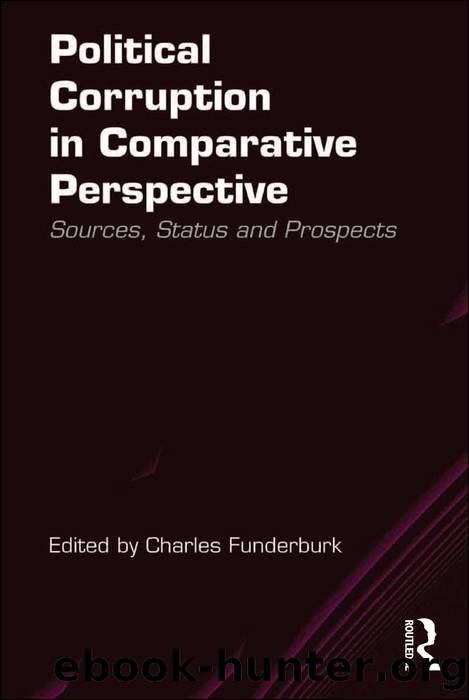
Author:Charles Funderburk [Funderburk, Charles]
Language: eng
Format: epub
ISBN: 9781409442516
Goodreads: 15065023
Publisher: Ashgate Publishing
Published: 2012-09-01T00:00:00+00:00
Status
1. Corruption takes lives: School construction in China
âIt was built out of tofu.â
Aggrieved parent in the wake of the collapse of his daughterâs school building in Sichuan, following the 2008 earthquake (quoted in Ramzy 2008)
âOur child wasnât killed by the earthquake. She and the others were killed by a derelict building. The officials knew it was unsafe.â
Parent of a daughter killed in the Sichuan earthquake (quoted in Spencer 2008)
Perhaps no recent incident in China reveals the human face of corruption more than the allegations of backroom deals gone terribly wrong following Chinaâs worst natural disaster in decades. The devastating human saga of the 2008 earthquake that decimated major sections of Sichuan province and neighboring regions was made worse by charges that many of the buildings and schools that collapsed were faulty in design, due to sweet deals and payoffs to local officials. This early spring earthquake, which occurred months before Beijing hosted the 2008 Summer Olympic Games, killed at least 68,000 people (rendering nearly five million additional people homeless) across a province known for its rich ethnic diversity as well as for its famed âhot and spicyâ foods.8
Shortly after the quake struck, it was painfully obvious that many children were in harmâs way. This fact, devastating in any situation, is even graver given the planned birth policies of the PRC, often referred to as the âOne Child per Coupleâ policy. It is possible that in some towns, an entire generation was lost in the quake (BBC 2008).9 Because of the political sensitivity of the death toll and immediate allegations of corrupt dealings, an accurate count of the number of school children who perished in the quake is difficult to find, although the toll is widely believed to be in the thousands. We do know, however, that one single schoolâs collapse took the lives of over 900 people, mostly children. Another crumpled school, in which over 1000 children died, had been previously condemned by the local government, but the factory to which it was linked had dragged its feet in building a replacement (Spencer 2008). We also know that those who have worked to publicize the egregious violations of building code standards responsible for many of these deaths have paid dearly.
Despite assurances by Prime Minister Wen Jiabao, who affectionately became known as âGrandpa Wenâ after his show of emotion and political will in the days immediately following the earthquake, that there would be a âfull and openâ investigation, the full picture has never clearly emerged. Arising from this fog of incomplete information are a few outspoken warriors including Ai Weiwei, an artistâactivist blogger known worldwide for co-designing the Beijing National Stadium (âBirdsâ Nestâ) of the 2008 Games, who has worked tirelessly to expose corruption scandals involved in the Sichuan school collapses. Ai and his investigative collaborator were both severely beaten by police in Sichuanâs provincial capital, leading to a cerebral hemorrhage believed to be linked to the police action (Branigan, 2010a, Fukuda 2009). Families who have pushed for investigation of the
Download
This site does not store any files on its server. We only index and link to content provided by other sites. Please contact the content providers to delete copyright contents if any and email us, we'll remove relevant links or contents immediately.
| Anthropology | Archaeology |
| Philosophy | Politics & Government |
| Social Sciences | Sociology |
| Women's Studies |
The Secret History by Donna Tartt(18993)
The Social Justice Warrior Handbook by Lisa De Pasquale(12175)
Thirteen Reasons Why by Jay Asher(8870)
This Is How You Lose Her by Junot Diaz(6854)
Weapons of Math Destruction by Cathy O'Neil(6243)
Zero to One by Peter Thiel(5759)
Beartown by Fredrik Backman(5706)
The Myth of the Strong Leader by Archie Brown(5479)
The Fire Next Time by James Baldwin(5408)
How Democracies Die by Steven Levitsky & Daniel Ziblatt(5196)
Promise Me, Dad by Joe Biden(5127)
Stone's Rules by Roger Stone(5065)
A Higher Loyalty: Truth, Lies, and Leadership by James Comey(4937)
100 Deadly Skills by Clint Emerson(4898)
Rise and Kill First by Ronen Bergman(4757)
Secrecy World by Jake Bernstein(4724)
The David Icke Guide to the Global Conspiracy (and how to end it) by David Icke(4677)
The Farm by Tom Rob Smith(4484)
The Doomsday Machine by Daniel Ellsberg(4472)
